
constellations #122: a marathon, not a sprint

Hi again,
Last month I ran my first marathon. In honor of its twenty-six miles, here are twenty-six thoughts about running, friendship, mantras, marathons, this particular marathon, and more.
***
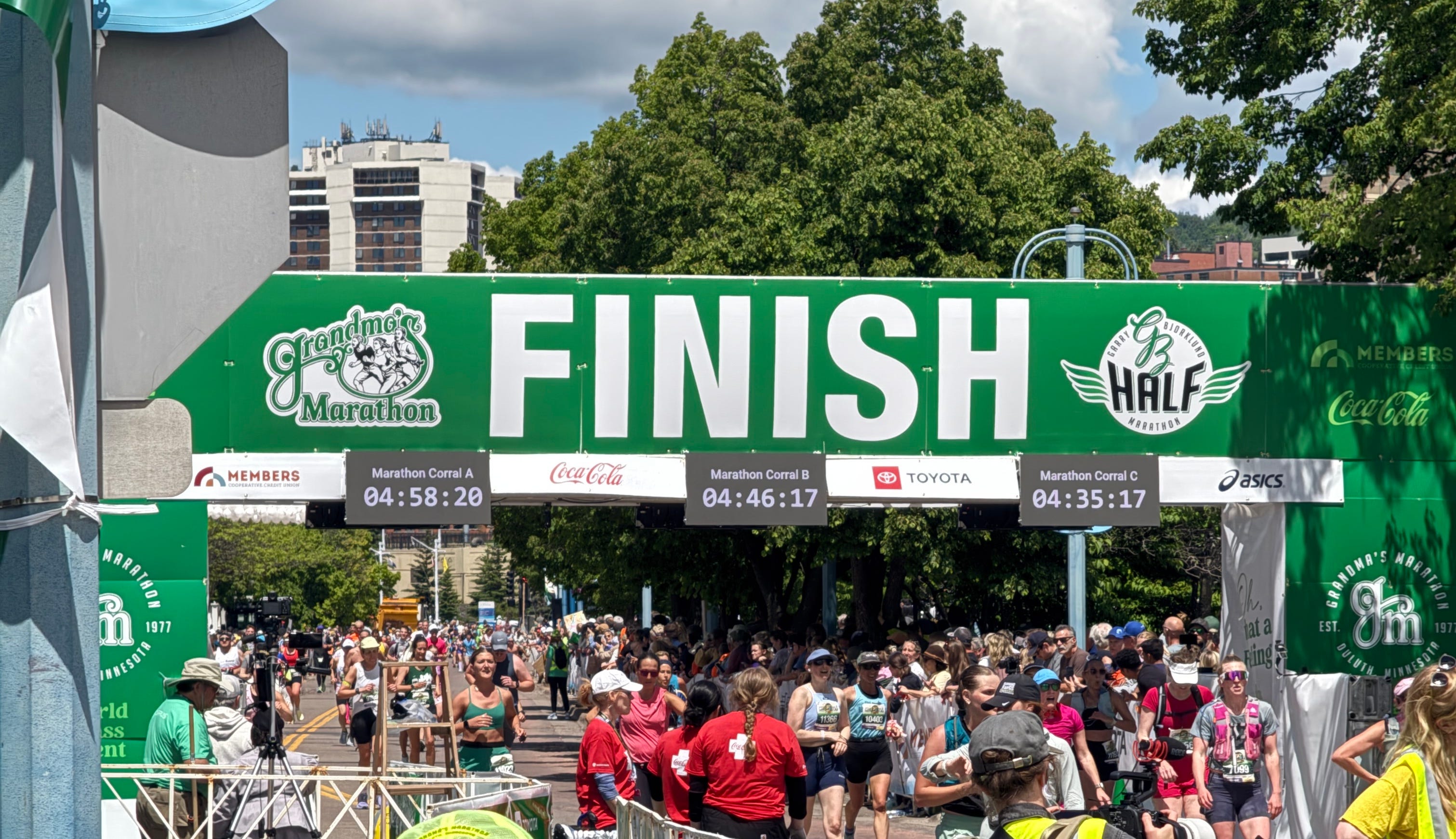
Moments after crossing the finish line of Grandma’s Marathon 2026, I feel worse than I ever have in my life. I can hardly walk. I can hardly think straight. I feel like I got hit by a truck. I look around at my fellow finishers in a daze. What a psychotic thing to do, I think to myself, over and over. Only a crazy person would do this.
Hours later, drinking a milkshake in a much-vaunted local ice cream shop, everything has changed: I feel elated. I am still wearing my medal, will wear it all day—how silly, how fun. I am still in pain but I feel like I have won the lottery.
I’ve run, on and off, for much of my life. It was mostly casual until my late 20s, when I made friends at work who identified as runners—for whom running was a great love of their life, and a structuring force within it. We started going on runs together, and I learned everything I now know from them: how to pick the right shoes, how to structure a week of workouts, how to stave off injury, what to wear when it gets hot, what to wear when it gets cold, whose names I should recognize, what races are the most fun (one of them even became my coach for a handful of the recent races I’ve done). They taught me the lingo and signed me up for Strava.
This changed my life: I became a runner, too.
What do you like about running? a friend asked me recently, and I was surprised I didn’t have an answer ready. Eventually, I said I like the structure that it gives to my time—something I really needed in the early days of the pandemic, shortly after I began taking running seriously, and again when I lost my job a few years ago. That answer is true but it isn’t everything, doesn’t account for the places I have only seen because I chose to go there on foot, the way this habit brings me closer to my friends, the sense of accomplishment it offers me, the rush of endorphins, the general pleasures of discipline. Running allows me a gentleness towards my body, ways of appreciating its strengths and forgiving its fallibility that are unrooted from the usual, more punishing external benchmarks (i.e., feminine beauty).
In return, all running asks of me is focus, diligence, patience, grit. These are qualities I am glad to foster.
“Running has organized my life and tenderized me with unexpected force,” the critic Ben Ratliff wrote in Run the Song, his recent book about music (listening to it, writing about it) and running. That’s exactly it, I thought when I first encountered the sentiment. (I wish that’s what I had told my friend.)
“That’s the other thing that I like about it—the throwing-yourself-forward aspect of it,” Ratliff said of running in an interview in Philip Sherburne’s newsletter last year. “Really just flinging yourself into the future. That really seems to me to be like life, you know—that’s living.” This is what it feels like, on my best days of running: a way of meeting the future.
I don’t often make note of the overlap between my running habit and my other creative pursuits, but that’s the crux of Run the Song. I like the way Ratliff describes that overlap, from that same interview: “I wanted [the book] to be a thing that was full of I don’t know what I’m doing energy,” he says. “Because that is the energy that I love to feel as I’m running.”
Before I ever ran one, a marathon represented, to me, a form of seriousness. As someone who has never run particularly fast or otherwise been a particularly gifted runner, I thought engaging with this seriousness would grant me some kind of validation.1 And so I kept pining after the goal, though life—and a series of minor injuries—kept getting in the way, putting off the dream another season, then another season, then another, which made the dream feel both bigger and further away.
But then this January, in a foreign city, I tell some friends that perhaps this is finally my year for a marathon. Immediately I backtrack; my other goals for the year—[redacted] and [redacted]—are extremely time-consuming, sort of dependent upon chance, and might wreck my mental and physical health, I say. So maybe I should drop the dream altogether? No, one friend says to me, eyes wide, encouraging, you should do the marathon, and she means it, because she has already run a couple, and she knows what it would take, what it would mean. Immediately our other friends echo her.
They’re right. This is, in part, how and why I wind up committing to run Grandma’s Marathon in Duluth, Minnesota, in June.
The race that made me fall in love with the very idea of marathons: the Tokyo Olympics, 2021. I’d never really followed professional running before, but my running friends were invested, so then so was I. In the marathon, we were all cheering for Molly Seidel, an American runner who had made her marathon debut at the Olympic trials—meaning that the very first time she ever ran a marathon, she ran it fast enough to earn a spot on the United States’ Olympic team. I started watching coverage of the race from home, but then a friend invited Matt and me out for dinner, and by the time we met up at our friend’s house, the lead women had perhaps five miles left. I asked, sheepishly, if we could please just maybe put it on the TV for a sec before we all went to the restaurant? (This, too, made me feel like a runner—caring enough about this race to subject friends to it.) That day in Japan was ungodly hot; even the veterans were struggling. But Seidel is gritty, and when she crossed the finish line and earned a bronze medal, I cried. An American woman hasn’t medaled since 2004, I tried to explain to my friends. This is only the third marathon she’s ever run in her life!
Later, I read an interview with Seidel about how brutal the race was. “Truthfully,” she said, “I wanted it as hard as possible.” She knew her competitors could pull off amazing times in great conditions, and she knew that perhaps she couldn’t beat them on a perfect day. But “when the going gets tough,” she said, “that’s my strong suit.” I wanted it as hard as possible: this philosophy inspires me.
For my marathon, my training does not go perfectly—a few injuries land me back in weekly appointments with my physical therapist, who tells me I can keep training, but I have to dial back the intensity, which eventually gets a little boring, and makes me worried about how I’ll feel on race day. But I stick with it (coached by my aforementioned friend-slash-running-mentor, whose enthusiasm keeps me motivated). I run when it’s hot, when it’s raining, when it’s so windy that my phone keeps alerting me to a “weather warning.” On one long run in Central Park, I get a speck of dust in my eye, and it hurts so bad I stop to look up the closest urgent care clinic. (It turns out I am overreacting; I am fine.) I run when I’m hungover, when I’m tired, when I’m traveling. I don’t always run well but I always run.
In 2018, Des Linden became the first American woman to win the Boston Marathon in decades. She says she was guided by a pretty straightforward mantra: Keep showing up. I know this because another of my beloved friends-slash-running-mentors, whom I sat next to every day at work for years, kept a Post-It note with this advice at her desk; I’ve never forgotten it.
In the midst of my training, a colleague is shocked when I mention that I won’t actually run 26.2 straight miles until the day of the race. This isn’t uncommon in marathon training; running that whole distance, even at a more relaxed pace, is very taxing on the body, and necessitates quite a bit of recovery time, which isn’t practical for most people. We try to brainstorm other things in life that require lots of preparation, but you don’t actually do until you do them. I’m stuck waffling between two possible answers: on the one hand, “death”; on the other, “basically everything.”
In the days just before the race, I am seized by anxiety, which manifests as an intense fear that I am being very annoying (not unfounded; I haven’t stopped talking about the race to anyone within earshot in weeks, not to mention I’ve dragged my spouse halfway across the country to accompany me to the race) and a sudden loss of appetite (challenging, as I’m supposed to be intaking an astounding number of pre-race carbs). At one point, Matt sees me staring at a bag of mini pretzels, near tears, anxious as hell, and reminds me to pace myself: Remember, he says, it’s a marathon, not a sprint. He laughs. Literally. His delight in his own dumb joke is contagious, so then I laugh, too. And then I can’t stop laughing.
After I land in Minnesota, another runner friend calls me and instructs me to download an app. They’ve solicited voice memos from a variety of friends, which the app will automatically play in my headphones during the race, mile by mile. The thrill of being (virtually) surprised by loved ones in the midst of this challenge—the idea of feeling their presence even though I’m a thousand miles away—is impossibly sweet.
When I ask other marathoners for advice—friends, acquaintances, people I meet over race weekend—they all say the same thing: Don’t go out too fast. Standing on the start line carries with it so much adrenaline; this means many runners fly through their early miles—especially first-timers, who have no idea what it’ll actually take to keep up that pace for 26.2 miles—and then totally burn out later in the race. There’s a hard way to run a marathon, my coach tells me, and a harder way. (Running out of energy midway through is the latter.) I internalize this advice. My mantras are piling up.
My friend with the Post-It note clocks my nerves and sends me some wisdom. “The training is the true test,” she says, “race day is a celebration.” When my alarm goes off at 4:45 a.m. on the morning of my race, I say this to myself: This is the celebration.
(I’m writing, here, about everything except the race. Maybe that’s by design? Or maybe I haven’t digested it yet, only everything else around it?)
After the race, Matt takes a picture of me holding some food that I know I should eat but feel too sick to consume. I send the picture to my sister, making a joke about how pathetic I look and feel. She texts back immediately: Sounds like pregnancy. (She is midway through her second trimester, soldiering through weeks and weeks of constant nausea). I laugh. I like that we are connected in this way: her own marathon-not-a-sprint; her own experience for which there is no adequate preparation until you’re in it. We offer each other solidarity.
Would I do it again? Even though it briefly took over my life, made me annoying, cost a lot of money, hurt like hell? Of course I would. Of course I will. It’s very rare that you hear someone say “I ran a marathon,” my physical therapist tells me a couple weeks later. It’s much more common to hear, “I’ve run marathons.”
I had put off signing up for a marathon for a long time because I wanted to get it right: be in the best shape of my life; pick the perfect race; nail the timing; set a challenging goal and smash it. This is, in fact, not how it goes down. Despite that, it still feels like nothing but victory. If I had waited for perfect conditions, I might have waited forever. I’m glad I didn’t. (I suppose this is wisdom I ought to apply to other areas of my life.)
What I will say about the race itself is this: My favorite mile is the final mile, where there is no longer a chance of burning out too soon, where I can only give everything I have left. I tell myself to burn the image of the finish line into my brain as I approach it. I tell myself I have no regrets. I hold nothing back.
Here are some other things I have been consuming lately: Lost Lambs by Madeline Cash; The Door by Magda Szabó; a quick day trip upstate to watch my sister at a horse show (one of my most cherished summer traditions); HARDBODY by deBasement; MY SKYSCRAPER by Nirosta Steel; Always Living Somewhere by Claire Ozmun; In Perfect Harmony by Joni Mitchell & James Taylor; What Ever Happened to Baby Jane?; Oh, Mary! starring Meg Stalter; this very wise interview with musician Wendy Eisenberg; a gay history walking tour of the West Village led by my friend Madeline; my friend Ben’s new podcast series about the history of Staten Island secession; dinner at Dinner Party in Fort Greene; pastries at Saison in Bed-Stuy; a sunburn
***
This time last year I was: thinking about boredom & placelessness; and before that, reminiscing about a camping trip that changed my life, asking my friends for their endorsements, considering limits, thinking about emo, and submitting to art
***
Thanks for reading! See you next 24th.
xo,
M
For the record, if a friend told me they were seeking this kind of external validation for their running practice, I’d say screw that; you don’t need a race to legitimize anything; you can define your relationship to running on your own terms; whatever you do is good enough; etc. Alas. (And as the mileage count goes, let’s mark this as the final .2)
This is so, so great, and even made me a little emotional (particularly as someone who has yet to do a marathon-length race, although in my case it'll be trail, not road, and who has been struggling through some annoying injuries for a while, and am about to find out if I'm over them or not). I love that mantra: "Keep showing up." I love the other one even more: “The training is the true test; race day is a celebration.” That is absolutely how I have felt in the races I've been lucky enough to run so far.
I also love how you articulate this: "the places I have only seen because I chose to go there on foot, the way this habit brings me closer to my friends, the sense of accomplishment it offers me, the rush of endorphins, the general pleasures of discipline." For me, more than anything, running is a way of entering landscape and getting to know places and terrains I never would otherwise (or at least not at such distances). On a solo trip to Barcelona last year, I ran around Montjüic and discovered a side of the city I'd never known in all my years living there. And when I visited Santiago de Compostela for a festival last fall, as much as I enjoyed the music, it was my Saturday-morning run along a stretch of the Camino de Santiago that has stuck with me in my memory.
Anyway: congratulations, and thanks so much for sharing these thoughts. To your next race!
actually you never ever have to shut up about running a marathon because it’s incredible! very much connect w your putting it off thing - i’m doing my second this year and am deeply unprepared compared to last time and am reminding myself of just showing up like Des ❤️