
constellations #117: lucy and venus
Also: email me about sandwiches!

Before we begin: Are you a writer or visual artist? Second question: What’s your relationship with sandwiches like? If you answered “yes” to the first question and are intrigued by the second question, email me. I am working on a just-for-fun new project and I’m looking for contributors. Thanks!
***
Hi again.
Last month I visited Mexico City.1 I was there with a group of friends, celebrating a beloved pal’s birthday. I wasn’t quite sure what to expect, but a few weeks before my trip, I told my friend Matt about my plans, and he raved about the city. He offered to send me tons of recommendations, but I told him my travel companions already had a dense Google doc itinerary. One thing he insisted on, though, was the National Museum of Anthropology. Or maybe he just suggested it and I recall insistence because I was so intrigued. I was an anthro major in college, and went to grad school in an adjacent field, and had even briefly flirted with the idea of continuing on into a PhD program. I still feel a kinship with the discipline, even though it’s been a decade since I really spent time studying it. So of course I’d want to go to an anthropology museum.
Anthropology, if you’re unaware, has four main fields: biological, archeological, linguistic, and cultural. My studies had focused mostly on the latter two. I was most interested in cross-culturalism, generally—the way our very notions of, say, time or space differ from place to place. (If that sounds too vague, the examples I usually give are these: How close should you stand when you’re talking to someone? Is directness in speech efficient or rude? How well do you have to know someone before you invite them into your home? You might take the answers to these questions for granted, or feel like they’re decided person-to-person, but in many ways they’re dictated by the messy unseen forces we collectively call “culture.”) In undergrad and grad school, my big research projects were about cultural constructions of gender, sexuality, and labor—how they get rendered in speech and in law. Anyway, all of that is to say that I loved anthropology but I didn’t take a lot of classes in archeology specifically. For whatever reason, those questions as long as history—of what makes us human, of where and how we developed the traits that make our species unique—didn’t intrigue me as much; as a result, my knowledge of the field is admittedly pretty limited.
The Museo Nacional de Antropología, however, is very much an archaeological museum. Upon arriving with my friends I realized this, and also realized that it’s massive, and then remembered that I had done no research about its layout or its collections. No matter. Everywhere we looked there was something genuinely miraculous: a reproduction of a Mayan mausoleum; ancient jade jewelry; a scale model of an Aztec city; stone carvings of mythological creatures. (Despite my insistence on visiting this museum, I was off the hook as the tour guide; another friend had visited Mexico a few times before, and speaks pretty good Spanish, and had been obsessed as a kid with the theory that the world was going to end in 2012 because of an ancient Mayan calendar, so she took the lead, for which I was grateful.) Even though I had never been hugely into archaeology, of course I felt astounded to learn about the civilizations that had risen and fallen, over thousands of years, in the place where we were standing.
The last room we visited was, ironically, the introduction to the museum. Its remit was more general; its placards described the discipline of archeology, and ethnography, and the broad-scale history of Mexico. Immediately I was struck by a skeleton, or really, a collection of pieces of a skeleton, situated in the museum as a reminder of the best of what archaeology can accomplish. The skeleton was found in Ethiopia in the ’70s by an American anthropologist. His team had been blasting “Lucy in the Sky With Diamonds” at the excavation site, so the skeleton came to be named Lucy. She’s about 3.2 million years old, an Australopithecus—a type of early human ancestor who were bipedal, like us, though their brains were much smaller. Anyway, Lucy is famous; she’s in basically every Anthro 101 textbook, which is where I first encountered her—celebrated because she was long considered to be the oldest known human relative. (I recently learned, though, that archaeologists have since changed their minds about this fact.)
I gasped when I saw Lucy in the museum. She’s famous!!!, I told my friends, putting my degree to work. I didn’t realize at the time that this was a replica, not the actual skeleton; still, there was something elemental, something transcendent, in looking at her, some line that stretched back from my present self to, say, the version of me who first met these friends, then back to the version of me that first learned about Lucy in college, then way back, past me, past all of us, past any human being I’d ever known or ever heard about, through three-point-two million years, to her.
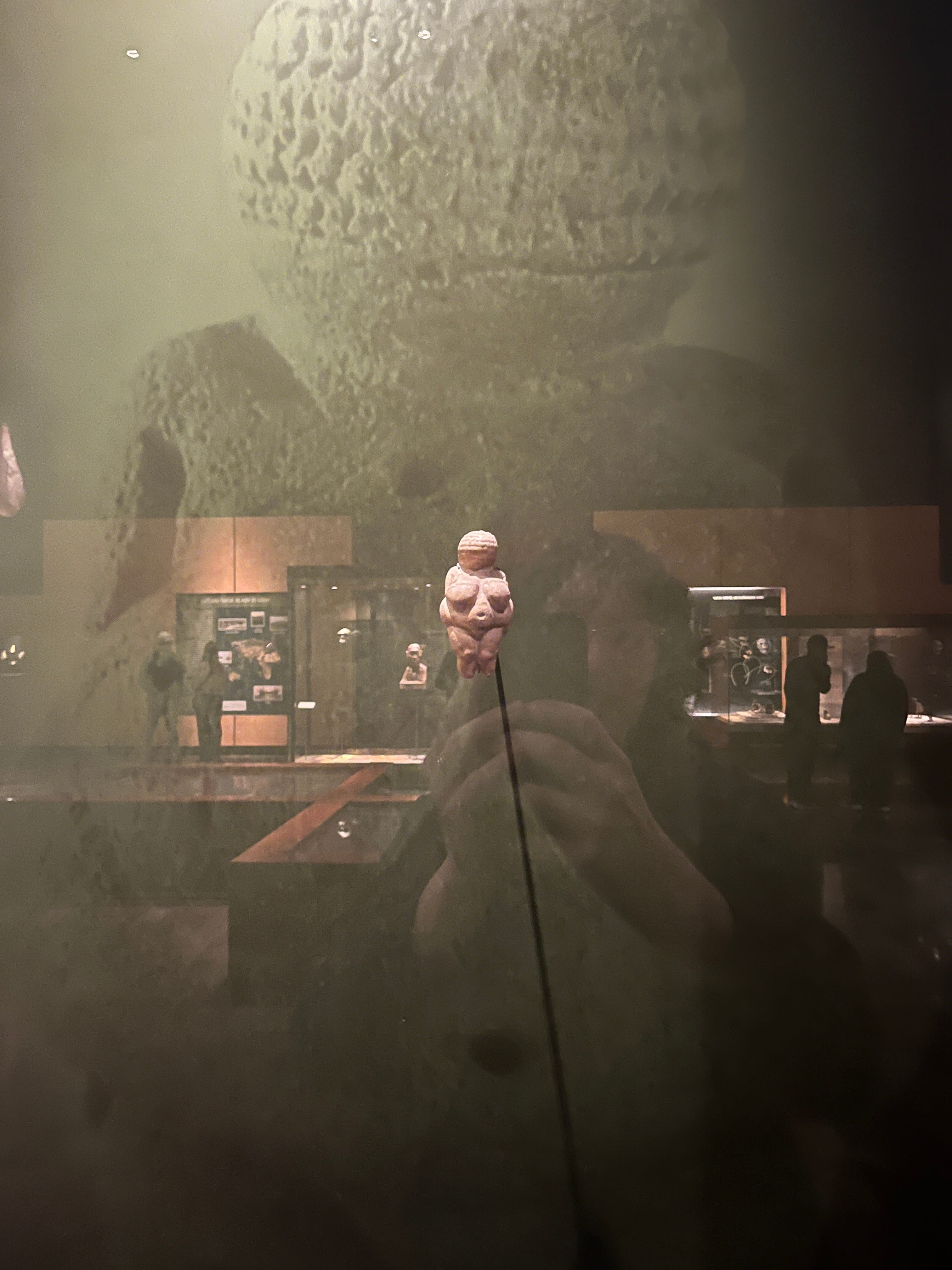
I spent a lot of time, too, looking at another artifact, just around the corner, that I also recognized from my anthro classes: the Venus of Willendorf. The sculpture (the original, that is; we were looking at a replica here, too) was found in Austria in the early twentieth century. It’s about four inches tall, and depicts a woman with exaggerated breasts, hips, and stomach, and braided hair. By the time she was discovered, similar sculptures had already been found across Europe; they’re all called “Venus” sculptures, after the Roman goddess of love and fertility, though these objects are much older than the Roman Empire. The Venus of Willendorf is estimated to be about 30,000 years old.
Why was she made all those years ago? Like so many archaeological artifacts, there isn’t a clear answer, only a handful of theories: that she’s a totem, a religious object, an aphrodisiac, a self-portrait. The plaque next to her said that she was perhaps created to represent fertility, which would be notable because it implies the Paleolithic humans who made her had the mental and cultural capacity to engage with abstract concepts—a development in the human mind that I try not to take for granted, genuinely. I felt a wash of gratitude come over me, reading the plaque, gratitude that 30,000 years ago, humans were making symbolic representations at all. Gratitude for art, generally, I suppose—that we have been taking abstract concepts and rendering them in some tangible form all this time. That we are driven to do this not because we know, or even think, that it will change the world around us but because it feels important, necessary, to do it. And also, and perhaps most presently, gratitude that I get to do it, too. Sometimes it all feels meaningless or hopeless, especially as “contemporary” “market” “forces” treat anything creative like it’s frivolous, and especially as so many people seem content to deprioritize human expression in favor of fast and easy AI slop. But standing there in the museum, I was reminded that creative work is also fundamental, primordial, inherent. And I was grateful for the reminder.
Here are some other things I have been consuming lately: Discipline by Larissa Pham; The Moment; Pillion; Almost Famous (for the first time!); Twin Peaks: The Return (life-changing, honestly), plus cherry pie from Petee’s in Clinton Hill to commemorate reaching the final episode; this essay about a mental breakdown; this essay about being a teenager inside (and outside) America; this essay about spiritual radicalism and pacifism; dinner at Smithereens, a New England-inspired restaurant in NYC, with Matt—imagine our delight; a Valentine’s Day cake from Clementine; homemade ratatouille for the first time in a long time; so much snow!
***
This time last year I was: thinking about throughlines; and before that, being a sucker, lying, revisiting seventh grade, and loving my cactus flowers
***
Thanks for reading. I hope something ancient makes you feel hopeful this month. Until next time.
xo,
M
I wrote most of this newsletter last week, but while I was looking it over this morning, I was also reading about the recent violence in Jalisco, a few states away from where I visited. Which is making me think about my own privilege as a visitor to Mexico (and the relationship between my home country and the places I visit…) I don’t have anything deep to say here, just that it felt wrong not to acknowledge the greater context of a place I am writing about. I am keeping the people whose safety is imperiled in my thoughts.